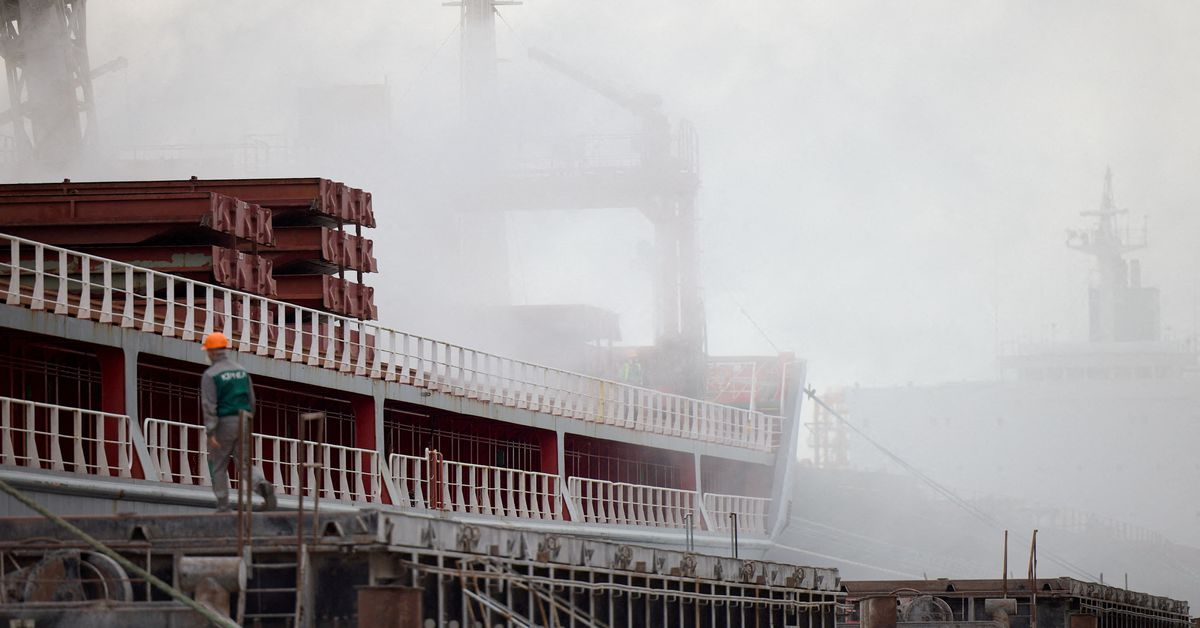

For landlocked Kazakhstan, connectivity features as a central pillar in its national strategy, wherein access to ports is essential to ensure year-round connectivity to global markets. However, in the wake of geopolitical shifts in Eurasia marked by Russia’s invasion of Ukraine and the weakening of the Iranian regime, supply chain disruptions have intensified. In light of these difficulties, Kazakhstan has sought out new conduits into the Indian Ocean, offsetting its current dependence on the Iranian ports of Chabahar and Bandar Abbas.
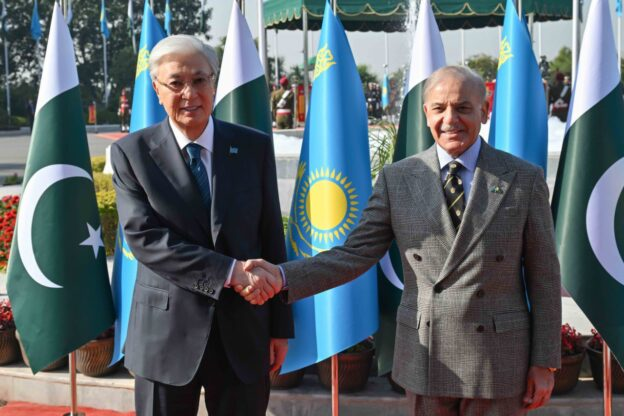
In this context, Pakistan’s primacy has grown in Kazakhstan’s strategic calculus, given its access to the Arabian Sea through the ports of Karachi and Gwadar. The recent visit of Kazakhstan’s President Kassym-Jomart Tokayev to Islamabad was indicative of a deepening partnership to build connectivity linkages between Central Asia and South Asia.
This growing convergence has come at the expense of India’s interests, although New Delhi is certainly aware that Kazakhstan’s turn to Islamabad has been driven by structural constraints. As Kazakhstan advances its southward push, India’s connectivity challenges and the broader viability of these alternative routes merit closer examination.
Kazakhstan’s southward push is anchored in a set of emerging transit initiatives aimed at reducing reliance on established northern corridors. Foremost among them is the Kazakhstan-Turkmenistan-Afghanistan-Pakistan transport corridor (KTAP), proposed in late 2024. During his recent visit to Pakistan, Tokayev emphasized the construction of a rail link in Afghanistan between Herat and Turgundi, which would serve to connect Central Asia to South Asia via Pakistan’s port of Karachi. According to media reports, if integrated into the International North-South Transport Corridor (INSTC), this route could extend access to Gulf ports and even to India, while diversifying trade routes and strengthening regional resilience. The project seeks to shorten transit time and bypass longer, more geopolitically complex routes.
A second important initiative is Kazakhstan’s participation in the Trans-Afghanistan Multimodal Transport Corridor Railway project, which it formally joined in July 2025. Astana had committed to investing in the Turgundi-Herat-Kandahar-Spin Boldak railway segment, alongside supporting the construction of the Termez-Kabul-Peshawar corridor to access the Arabian Sea. The plan includes developing logistics hubs in Herat and Peshawar, with fiber-optic infrastructure to strengthen digital connectivity along the route.
Complementing these efforts is the attempt to integrate the Trans-Caspian Transport Corridor (the Middle Corridor) with Afghan transit routes, effectively connecting Pakistan onward to Azerbaijan, Georgia, Turkiye, and European markets via the Caspian Sea. This would situate Kazakhstan within the broader north-south and east-west trade matrix, enhancing its role as a transit state.
Recognizing the security and logistical challenges posed by Afghanistan’s terrain, Kazakhstan is also exploring an alternative alignment linking Karachi port to the Dostyk-Alashankou corridor through Pakistan’s Haripur region and onward via the Karakoram Highway to China, with Russian technical support. It will further integrate with the China-Kazakhstan railway system. This route is projected to reduce cargo transport time and costs by up to 30-40 percent.
While Kazakhstan’s southward corridor diplomacy appears ambitious, operationalizing these projects could be easier said than done. Routes passing through Afghanistan won’t be easy to materialize as the country remains one of the world’s most unstable states, posing security and political risks to infrastructure development. Mountainous terrain further complicates railway construction, with differing rail gauges across countries adding technical challenges. Afghanistan-Pakistan border issues and strained India-Pakistan relations make the construction of routes across South Asia complicated.
Moreover, a comparison between the Iranian ports of Bandar Abbas and Chabahar and the Pakistani ports of Karachi, Gwadar, and Qasim reveals capacity disparities. At present, Pakistani ports are less upgraded and have lower freight capacity than their Iranian counterparts, due to structural and institutional barriers. Therefore, the implementation of the aforementioned routes for Central Asia-South Asia connectivity will be challenging.
While Kazakhstan seeks diversification and to benefit from the potential of both Indian and Pakistani markets, the practical architecture of the proposed routes tells a narrower story. Most corridors under discussion hinge on transit through Pakistan or Afghanistan, leaving India in a peripheral position. Yet meaningful regional integration is difficult to imagine without India’s participation.
Ad
However, the geopolitical reality is stark. India does not engage in overland trade via Pakistani territory, and given persistent bilateral tensions, such connectivity remains implausible in the near term. This structural constraint has long impeded region-wide initiatives, most notably the stalled Turkmenistan-Afghanistan-Pakistan-India (TAPI) pipeline.
At the same time, uncertainty surrounding Iran’s Chabahar Port following the end of the U.S. sanctions waiver in April has further complicated India-Central Asia trade. Although current India-Central Asia trade volumes through Chabahar remain modest, it has been integral to the long-term vision of the INSTC alongside Bandar Abbas. Any disruption, therefore, carries strategic consequences that extend beyond immediate trade figures.
Taken together, these constraints help explain why Pakistan is increasingly positioned as Kazakhstan’s principal South Asian interlocutor. Political friction and logistical barriers limit India’s integration into the evolving connectivity frameworks, even as the broader promise of Eurasian integration remains contingent on its inclusion.
Pakistan has emerged as a significant gateway in Kazakhstan’s effort to deepen connectivity with South Asia, particularly as Astana seeks to diversify supply chains and secure access to the Arabian Sea amid sensitivities surrounding Iranian ports. This shift, however, should be understood as diversification rather than substitution. Pakistani ports are unlikely to replace Iranian routes; instead, they function as supplementary corridors alongside Kazakhstan’s continued engagement with the INSTC.
At the same time, Pakistan’s domestic political volatility and persistent security concerns, which have affected major initiatives such as the China-Pakistan Economic Corridor (CPEC), point to broader uncertainties. Ultimately, the success of these proposed routes will depend less on strategic intent and more on overcoming structural barriers in Afghanistan and Pakistan. Connectivity may be the foundation of Kazakhstan’s regional strategy, but its southward ambitions might be tested by the unresolved India-Pakistan divide for a prolonged period.