Terrorism returnsto Delhi with atroubling new profile
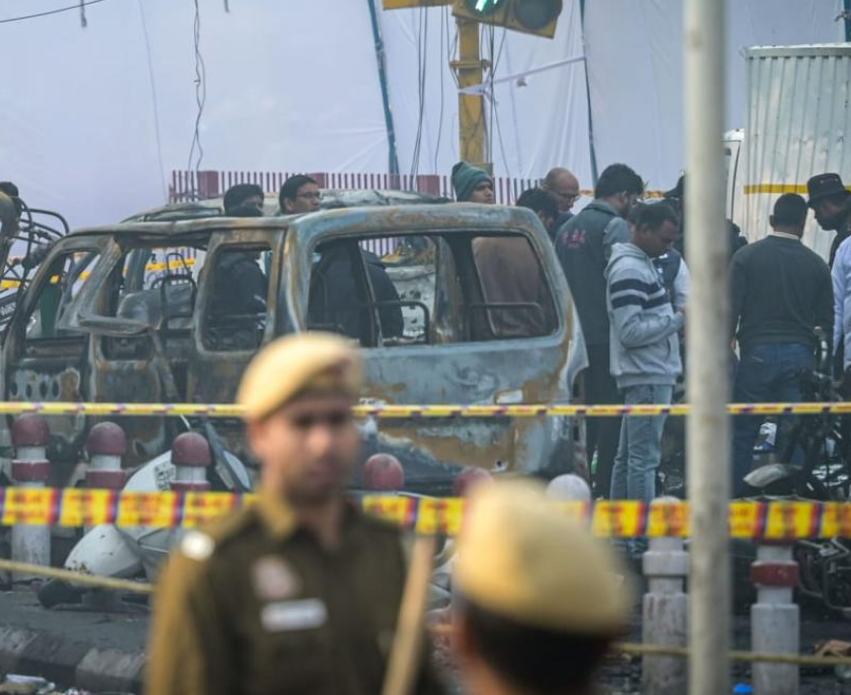
Six months ago, a terrorist attack in Kashmir brought India and Pakistan to the brink of all-out war. Just as the Pahalgam massacre began to fade somewhat from public memory, a car explosion near Delhi’s iconic Red Fort that killed 13 people last week offers a grim reminder of national vulnerability. Terrorism has returned to the capital after a 13-year hiatus.
The gist: Around a month ago, the Jammu and Kashmir police started investigating posters promoting Jaish-e-Mohammed, a Pakistan-based terrorist organisation, in Nowgam, near Srinagar. This led them to a Kashmiri doctor in Uttar Pradesh, as well as a group of doctors associated with a medical college in Faridabad, a satellite city of Delhi. Raids in Faridabad led to the recovery of nearly 3,000 kilograms of matériel, and several key arrests.
Another doctor of Kashmiri origin escaped the law enforcement dragnet and is now suspected to be the one behind the wheels of the explosive-laden car that blew up. Notably, federal investigators have gone on record describing the driver as a “suicide bomber”. Further, in a macabre turn of events, the explosives recovered in Faridabad were transported by authorities to Nowgam as a matter of procedure where they accidentally detonated in the local police station on Friday, causing at least nine deaths.
Soon after Pahalgam, the government assessed with a high degree of confidence that it was the handiwork of foreigners. This assessment became visible in the manner in which it handled the attack’s immediate aftermath, by publicly roping in the external intelligence, defence, and diplomatic apparatuses.
This time around, that has not been the case.
From the get-go, the government delegated the investigation to the Home Ministry and made sure – through how it publicised deliberations – it was not seen as prejudging the external dimensions.
In fact, for 48 hours it refused to officially link the car explosion to terrorism. When the government did, it did so gingerly – at least by recent standards – calling the explosion a terror “incident” as opposed to an “attack”, the former much less definitive than the latter. By pinning it on “anti-national forces”, the government seems to signal a domestic focus, given the colloquial use of that phrase in India.

Optics aside, three aspects of the incident make it worrisome.
First, the discovery of a large quantity of high explosives less than 50 kilometres from the heart of the Indian state. As callous as it may sound, this is what makes the events of last week stand out, not the number of fatalities.
Increasingly, evidence points to a conspiracy that played out in the vast urban and semi-urban territory adjoining Delhi, an area highly connected by road and yet, quite sparse in parts by population. In other words, the region offers the right combination of ease of travel and privacy. The very things that have made it so attractive to working professionals of all stripes now come to haunt it.
Equally problematic, a cloud of suspicion – much of it unspoken and unfounded – now hangs over millions of Muslims. Left unaddressed, this is a slow road to the hell of religious unrest, an outcome that would no doubt greatly please the perpetrators.
Second, the alleged conspirators. “White-collar terrorists”, as the Indian media labels them, are not a new phenomenon. For example, the Indian Mujahideen, a home-grown terrorist organisation active between 2005 and 2013, once counted a former senior engineer at Yahoo as a potent functionary.
Nevertheless, the involvement of several doctors, including a non-Kashmiri woman, seems to have hit a nerve. In a culture fixated with social roles, medical doctors are often considered beyond reproach, and remain extremely trusted.
Many fear highly educated professionals will come to play the same role in the country’s terrorism scene as organised criminals once did. To wit, networks of relatively affluent professionals can not only marshal their own financial resources and prosecute plots unmolested, but also sound out the like-minded through work ties, while their geographical bases – in or near India’s major urban centres – furnish familiar, accessible targets.
“The past”, the famous Faulkner line goes, “is never dead”. This brings us to the third reason why the events of last week rankle many.
Between 2005 and 2013, there were 37 terrorist attacks in India, not counting ones in Jammu and Kashmir and other insurgency-affected areas. More than half are attributed to the Indian Mujahideen. And four out of these were in Delhi, including one on 29 October 2005 that involved serial-bombing densely-populated markets, killing 67 people.
The Indian Mujahideen was born out of grievances against the country’s majority, in particular the destruction of a 16th–century mosque by Hindu fanatics in 1992. Kashmir was marginal in their worldview. Another group, Lashkar-e-Tayyiba (LeT), was conceived to “liberate” Kashmir, but soon pivoted to the business of global jihad. And yet the Indian Mujahideen and LeT formed a potent partnership, which included bombing trains in Mumbai in 2006 killing more than 200.
The worry, then, is that something analogous could be afoot — a return to a “hybrid” form of terrorism in India, involving actors both foreign and domestic.