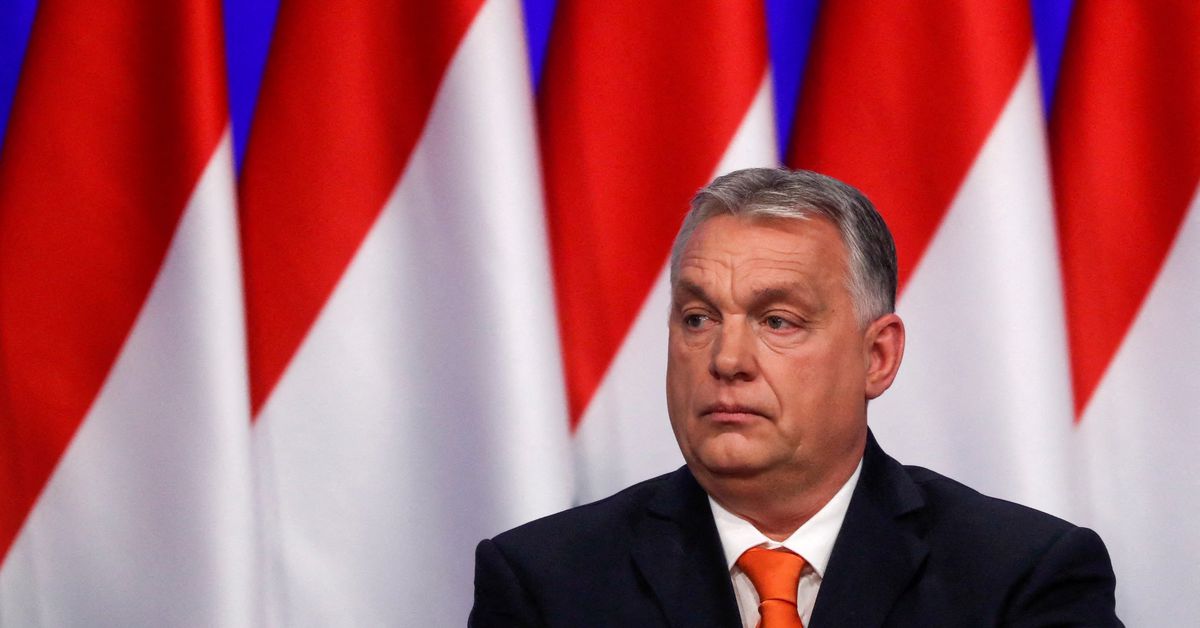

Hungarian Prime Minister Viktor Orban delivers his annual state of the nation speech in Budapest, Hungary, February 12, 2022. REUTERS/Bernadett Szabo/File Photo
BRUSSELS, Feb 15 (Reuters) – Hungary and Poland are turning increasingly authoritarian, a European rights group said on Tuesday, a day before the European Union’s top court rules on whether to cut funding to member states flouting democratic rights and freedoms.
The Berlin-based Civil Liberties Union for Europe singled out the two formerly communist EU countries in a broader report highlighting how the rule of law has deteriorated across the 27-nation bloc during the coronavirus pandemic.
The umbrella advocacy, which brings together rights groups from 17 EU countries, said Hungary and Poland were “seizing further control of the justice system, civil society and media, while cutting basic human rights and fuelling divisions by scapegoating migrants and other minority groups”.
Register now for FREE unlimited access to Reuters.com Register
Warsaw and Budapest deny wrongdoing and accuse the EU of imposing liberal values alien to what they say are their traditional, conservative and Catholic societies.
Hundreds of billions of euros are at stake in the rule of law battles in the EU. The bloc’s cohesion and international standing have been damaged by the increasingly bitter dispute.
Thirty-six billion euros in recovery funds earmarked for Poland, and 7 billion euros for Hungary, are already frozen over their track record on democratic rights and values.
Hungarian Prime Minister Viktor Orban has accused the EU of waging a cultural “jihad” on Hungary, while Warsaw has threatened to retaliate by stalling progress in other EU policies where decisions are made by consensus.
If, as expected, the Luxembourg-based European Court of Justice upholds the EU’s new policing tool, the bloc would take some weeks to start the process of cutting funds.
That means no money would actually be forfeited before the Apr. 3 election in Hungary where Orban faces the tightest race yet since his 2010 landslide victory.
It could take until the end of the year or early 2023 to get to that point, if ever, according to one EU official.
A senior EU diplomat expected the “cash-for-democracy” sanction to eventually be enacted but said it would have to be applied carefully so as not to risk blocking decisions on climate or foreign policy. The diplomat predicted much more horse-trading ahead.
Register now for FREE unlimited access to Reuters.com Register
Additional reporting by John Chalmers Writing by Gabriela Baczynska Editing by Mark Heinrich
Our Standards: The Thomson Reuters Trust Principles.