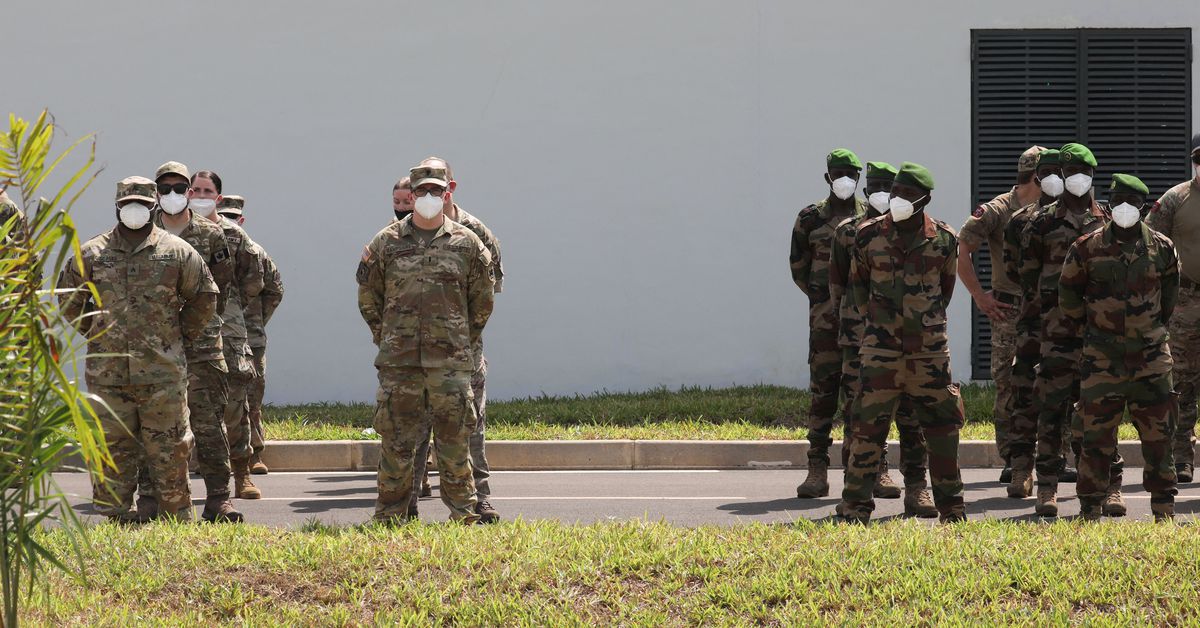
Participants stand at ease during the opening ceremony of the U.S. sponsored Flintlock exercises at the site of the new French-backed international counter-terrorism academy in Jacqueville, Ivory Coast February 20, 2022. REUTERS/Luc Gnago
JACQUEVILLE, Ivory Coast, Feb 20 (Reuters) – The United States’ yearly counter-terrorism training program for African forces began on Sunday in Ivory Coast at a time of upheaval in which Islamist fighters control large areas, coups are on the rise and French forces are winding down.
The training program, known as Flintlock, will bring together more than 400 soldiers from across West Africa to bolster the skills of forces, some of which are under regular attack by armed groups linked to al Qaeda and Islamic State.
Those not present included forces from Guinea and two countries worst-hit by Islamist violence, Mali and Burkina Faso. Military juntas have snatched power in those three countries since 2020, raising concerns about a return to West Africa’s post-colonial reputation as a “coup belt”.
Register now for FREE unlimited access to Reuters.com Register
Central to this year’s training is coordination between different forces fighting the same enemy.
“A main focus of Flintlock is information sharing. If we can’t communicate, we can’t work together,” said Admiral Jamie Sands, Commander of the U.S. Special Operations Command Africa, at the opening ceremony.
Islamist militants roam across large areas of the Sahel, the arid band of terrain south of the Sahara Desert. Mali, Niger and Burkina Faso have been overrun by attacks since 2015 that have killed thousands and uprooted more than 2 million people. Security experts say insurgents have infiltrated coastal countries including Benin and Ivory Coast.
The groups ghost across poorly-policed borders, confounding a mosaic of local and international forces who have spent billions of dollars trying eliminate the threat.
France has led the fight against the militants since 2013, but popular opposition to its intervention has grown. Last week it said it would leave Mali, moving instead to Niger.
Diplomats fear the exit of 2,400 French troops from Mali – the epicentre of the violence – could destabilise the region further.
Register now for FREE unlimited access to Reuters.com Register
Reporting by Ange Aboa; Editing by Edward McAllister and Toby Chopra
Our Standards: The Thomson Reuters Trust Principles.